Number 43 in our series of published wine writing competition entries comes from Jen Causton.
I am a 38-year-old female, married with two young children, and live in south-west London. By day I am an investment analyst; by night, I study for the WSET Diploma. Early mornings and weekends, I cook and write a food and wine blog.
CLEAN EATING? DIRTY DRINKING?
Fuelled by bloggers – notably in London, the US and Australia – vegetarianism and veganism are fashionable again as part of the clean eating movement, one of the hottest food trends to emerge in the last couple of years. At its simplest, clean eating is about choosing natural foods, and shunning processed. However, many advocates have moved to plant-based diets – which certainly sounds a lot more appealing than veganism. At the other end of the scale, however, there’s the elimination of certain food groups – such as dairy and gluten – but really for many of us, clean eating isn’t prescriptive and has merely made us more aware about upping our vegetable intake.
Be it a fad, or a more sustainable way of eating, this health-conscious movement has moved veganism on from mung beans and tofu, fortunately. Supermarkets are now stocking previously unheard-of ingredients – chia seeds, maca powder and coconut oil, to name but a few – meanwhile the extolling of the virtues of less exotic ingredients such as sweet potatoes (not just limited to savoury meals), avocados (#avotoast) and kale (strange but true) is dominating social media.
For the die-hards of clean eating (virtually tee-totals by the sounds of it), unfiltered vodka with lime juice and sparkling water seems to be the (very occasional) alcoholic beverage of choice, but many of us – even with our pledge to embrace the clean and ban the dirty (processed) – still wish to enjoy a decent glass of grape juice with our meal. Even if our plates are now dominated by vegetables and ingredients with unpronounceable names.
Food and wine pairing rules generally advocate matching acidity and weight. Traditionally, a white wine is usually thrust at vegetable dishes due to that wine's higher acidity. And in many cases this is appropriate – why choose Châteauneuf-du-Pape over Sancerre with a goat’s cheese salad? But what happens when you get on to your main course of vegetarian pasta bake (gluten-free, optional) or in winter when you’re craving a rustic red from Languedoc-Roussillon? Will our enthusiasm for more vegetables condemn us to a life of white wine or that acidic, everyday drinking Italian red that claims it 'goes well with pizza' (in English) on the back of the bottle?
Absolutely not. For many of my meals, I have a wine in mind first and the food just has to match rather than being held hostage by a salad when, frequently, I want to drink a full-bodied red. Sweet potatoes, mushrooms and aubergines are go-tos when it comes to pairing food with big wines. The latter are delicious cooked with a generous amount of oil, which increases the perception of body and can work well with those wines such as Barolo which come into their own with fatty meat.
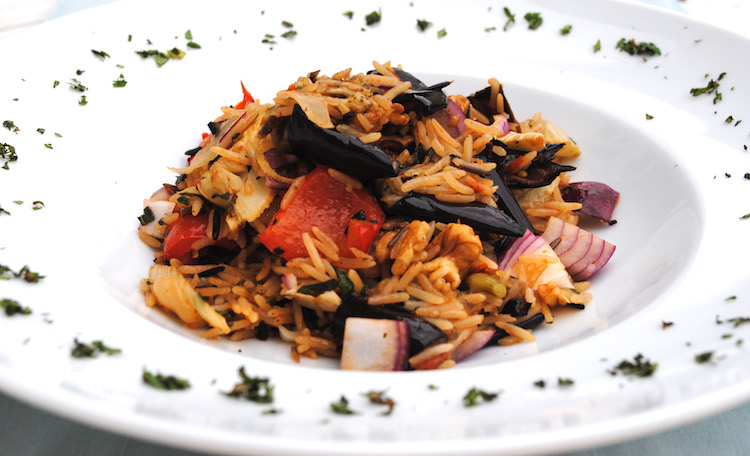
Wild rice with aubergine, fennel, mint and walnuts
Puy lentils are great for adding body and work nicely with Old World Syrah such as St-Joseph, and, of course, Le Puy (the legumes are also terroir-driven) is not a million miles away from the Rhône Valley, which pays homage to the regional pairing rule. Roasted beetroot and/or roasted pepper give sweetness and complexity, especially with those wines where primary fruit is the main concern. For older red wines, boost the lentils’ earthiness with celeriac and the meaty mushroom. For a sweet and textural contrast – which will also work with white wines such as a barrel-fermented Chardonnay – use hazelnuts.
The uptick in veganism has led to an increased usage of nuts for a protein source – peanut butter is not the only game in town and its allies are far less carpet-like. Nut butters such as almond and cashew can add flavour, but possibly more importantly for the wine enthusiast, they can give the perception of body to the simplest vegetarian dish. Pepping up a dressing with a teaspoon of cashew butter, for example, takes away some of the acidity, especially when it’s tossed over some lightly steamed vegetables, rather than a green salad. If you are feeling experimental, try walnuts – in a beetroot risotto – for example, with a less austere New World Cabernet Sauvignon. And for an aperitif, buck that classic pairing of roasted almonds and fino sherry by serving roasted, salted nuts with champagne or chablis.
One tendency I do follow, however, is to steer clear of red wine with leafy green vegetables. That said, a lighter red – don’t waste your complex Burgundian Pinot Noir though – can be successful with a chunky pesto or salsa verde-type condiment, especially one that incorporates other herbs or flavours beyond basil. Introducing a leaf of the darker green variety, such as kale, can make for a bigger, less acidic sauce that works well with something like Carmenère or Cabernet Franc – choose something from Friuli to stay true to this wonderfully tweakable sauce’s Italian roots.
High-acidity Italian reds tend to be hailed as the poster child for vegetarian dishes due to their propensity to incorporate tomato sauce. But this humble staple is far more flexible than it is given credit for and makes an excellent conduit for adding body and flavour. Make a more complex and flavoursome sauce by giving those tinned tomatoes (unless you are lucky enough to have an abundance of fully ripe fresh fruit) their necessary simmering time – and I mean more than 10 minutes – after your onions and garlic have been fried to a melting sweetness. Add blitzed roast peppers and ground almonds to give the sauce a richness that commands more than a mass-produced Chianti or simple Montepulciano d’Abruzzo: I’d be reaching for an Aglianico or straying to the New World for a Napa Cabernet Sauvignon or a Barossa Shiraz.
Other tricks with this essential sauce can bring that Marmite wine, Pinotage, into the fold. It will team nicely with a veggie dish slathered in a tomato sauce with a pinch of smoked paprika or, indeed, Marmite itself. Replace the latter with miso if you’ve given up yeast. Capitalise on the popularity of halloumi – lightly dust with smoked paprika before marinating in lime, olive oil, garlic and rosemary prior to grilling – and then serve with your sauce for a brilliant barbecue dish (and yes, this will stand up to Malbec too). For a more wintery meal, embrace the richness of roasted sweet potato and smoky tomato sauce with your Pinotage, which will also work well with the bold, ripe fruit of Zinfandel. Sweet potatoes are pretty versatile though; try fuller whites such as Chenin Blanc, white rioja and New World Chardonnays.
Elsewhere, aromatic Pinot Gris, Riesling and Gewürztraminer are traditional with curry but don’t limit yourself to whites if you are making a tomato-based Indian dish. A fruity Grenache aged in big old barrels could work, or maybe a fresh Cabernet Franc grown at higher elevations such as in the Andes. For Mexican food, look out for a restrained Zinfandel should you fancy a red wine.
The rise in dairy intolerances means that vegetarian dishes can’t always hide behind a liberal application of cheese any more, and restaurants are becoming more imaginative. Of course, the ubiquitous mushroom risotto is still prevalent but at home, lace it with truffle oil and serve with a Barolo/Barbaresco or an aged red which has savoury, gamey notes, such as Hermitage. A similar dish could be a credible option for good-quality bordeaux as well. Mushrooms, with their umami and earthiness, will complement left-bank and right-bank wines, with the additional of truffle for those older Merlots. Echo these flavours with roasted celeriac and Jerusalem artichokes, with chestnuts, to give body.
One of the joys of wine is its subjectivity – you will have your own palate, both with wine and food – and its sociability. Get a bunch of friends around, experiment for that eureka! moment, discuss your views – what flavour profiles work, what doesn’t – and if there’s a clash, simply just move on…
TURNING AROUND A JUGGERNAUT (WHILE BREAKING DOWN BARRIERS)
The decision to tackle Spain at our next wine club evening was met with reticence. 'Spain – it’s a bit obvious.' Or 'shame we can’t focus on a specific region like Ribera del Duero'.
Spain was certainly not my first choice of areas to explore (particularly after a fascinating session involving old Chenins of South Africa the previous session) but it offered a good excuse to knuckle down and learn about this perceived behemoth of cheap wine. And, if anything, it made me realise that if we'd chosen the aforementioned ‘prestigious’ region, it would not have helped us avoid any wines of suspect quality.
I am sure many a reader will sympathise with our reactions. After all, Rioja is often that ‘reliable’ wine one inevitably goes for if ordering a glass of red at the average pub; plus how often do we see Spain and terroir in the same sentence? Yet consider the international success of the Palacios brothers, López de Heredia, Vega Sicilia, Dominio de Pingus and Priorat, to name but a few. But with the exception of these superstars, what does Spain need to do to shrug off its all-consuming reputation for utilitarian, inoffensive wine – intended to appeal to the masses, but inspiring the minority?
There is strong evidence that Spain will continue to be a favoured source for cheap wines. Despite the gentle decline since 1980, Spain’s aggregate grape-growing area remains the largest in the world. Yields have increased but, partly due to sketchy irrigation, still lag behind those of France and Italy, thus Spain currently resides as the world’s third-largest wine producer. Export volumes may have been hitting new highs in recent years, but profits are slumping. Although Spanish wine export volumes easily outpaced those of France in the last year, the latter’s export revenue exceeded Spain’s by more than three times, while Italy generated almost twice as much. This is even more ironic when one considers that France and Italy are Spanish wines’ biggest importers, and re-export a proportion of its unbranded bulk wine.
While Spain’s pricing power clearly leaves a lot to be desired, it is a Mecca for cheap wine quite simply due to the bountiful supply of grapes, naturally keeping a lid on prices. The plentiful hours of sunshine and reasonably stable climate (certainly compared with that of France and many parts of Italy) make ripening a cinch. As well as the Atlantic ocean (and the Mediterranean to a lesser desgree), elevation acts as a moderator; Spain is the second most-elevated European country.
Socioeconomic factors have also dealt the Spanish wine industry a helping hand over the years, ranging from phylloxera – which sent Bordeaux winemakers and their expertise south to Rioja – to EU membership. Economic aid to bolster Europe’s competitiveness against New World players funded advancements in winemaking technology. Meanwhile, the legalisation of irrigation was manna from heaven for many growers, particularly those in central Spain. The scarcity of rainfall had meant that vines needed to be planted relatively far apart to minimise competition for water, naturally keeping yields in check. Irrigation also opened up the ball game for new areas initially considered too dry to plant.
As such, Spain garnered its reputation for ripe, jammy fruit bombs, produced in bulk in arid areas. The full-bodied style, softened with oak, was particularly well received in the US and rivalled fruit-forward wines from Chile and Australia with regards to value for money. Rioja became – and remains – the most well-known region for this reason even though most wine enthusiasts would be hard pushed to disregard it as a premium area.
The 2008/2009 financial crisis, followed by the peripheral crisis in 2011 – which remains a headwind today – resulted in softening demand and the cessation of EU subsidies. As such, Spanish vineyards have faced diminishing profits with little left over to invest in new technology and keep on top of their game. That said, keeping up with innovation has not been at the forefront of many producers’ minds; the lack of credit availability to keep their business as a going concern has undoubtedly been more pressing.
While margins are wafer-thin for many, it is difficult to be nimble in response to any developments in consumer trends, such as a shift to lower yields. Spain’s reputation for cheap wine is now proving to be a double-edged sword; in the main, winemakers are struggling to market anything that doesn't conform to expectation, such as creating an elegant, subtly oaked rioja for example.
Current regulation is also proving to be unhelpful for those producers embracing quality and ultimately creating a wine they feel best expresses the land. Rioja, Spain’s best known and second-largest appellation, has just one appellation. On the plus side, the vast region – albeit in its entirety – has been awarded the higher accolade DOCa but considering that Burgundy, less than half its size, has 100 AOCs, it’s little wonder that there is growing pressure for regulations to differentiate between subregions.
Spanish wine laws and consequently the broad marketing strategy are centred on ageing, with no regard for quality. Labelling in Rioja is not permitted to distinguish a single vineyard – or even a village – wine from one that has been blended from grapes across the entire region. Whilst this has exacerbated mass production, it means that producers who wish to showcase the rich variety of land, rather than inhibit with oak, potentially miss out. The marketing message from the rules around ageing suggests that Gran Reserva is superior to that of Crianza, for example, merely on the time it has spent in oak and then bottle before release. And given rioja’s momentum in the international markets, other areas of Spain have followed suit and adopted this emphasis on the ageing – with the exception of Priorat.
Indeed, there has been little to endorse the terroir and hence diversity of wines across Spain. Therefore, it remains too easily dismissed as an arid land mass producing easy-drinking, relatively alcoholic and full-bodied red wine despite the international success of Albariño, for example. But there are numerous other examples of both regions and winemakers bucking the trend. Elsewhere in Galicia, racy and complex Godello from Valdeorras – with its more continental climate and granite soils – has the potential to be compared with top-quality burgundies, albeit with an Atlantic elegance. Amazing to think that Godello was rescued from near extinction a few decades ago. To the west of Valdeorras lies Galicia’s oldest DO, Ribeiro, which is rediscovering its native white grapes – Treixadura, Torrontés and Lado, to name but a few – whereas its north-eastern neighbour, Bierzo, is slowly gaining traction for its delicate yet lively reds. The star of the show here, Mencía, traditionally produces fresh and relatively aromatic wines with peppery red fruit and violet aromas but some winemakers are now experimenting with subtle oak ageing, which is leading to fuller-bodied examples, exhibiting darker fruit, chocolate and more savoury notes, while still reflecting the mineral-rich terroir.
Speaking of fresh reds, blend-friend Garnacha, regardless of origin, tends to be associated with ripe, low acidity and powerful wine. The new wave of winemakers in Mentrida, however, are defying this convention with their fresh, classy Garnachas, not dissimilar in body to Pinot Noir. Lying just to the south-west of Madrid in the province of Toledo, Mentrida is pretty much the centre point of Spain, and part of the massive Castilla-La Mancha – that vast arid region responsible for almost half of the country’s wine production. Given Mentrida’s extreme continental climate – with summer temperatures reaching 45 ºC (113 ºF) – lively acidity balanced with fruit and complexity is being achieved by planting at high elevations (up to 800 metres/2,625 ft) to harness the massive diurnal range. A shift – albeit slowly due to lack of funding – to stainless-steel equipment, gentle extraction and ageing in large oak vats is aimed at showcasing minerality and ultimately expressing the terroir.
Conversely, Priorat – same grape, different profile – often provokes the reaction 'oh I don’t want to pay that much for Spanish wine'. At odds with the majority of Spain, Priorat’s emergence less than 30 years ago has been synonymous with high-quality wines, with prices to match.
But high demand is not the overriding reason why Priorat is structurally, albeit relatively, expensive. In fact, a keenly priced specimen should be viewed with suspicion, given the cost of working the sheer slopes and the scarcity of both the old vines and the region’s trump card – llicorella shale (obviously finite). Moreover, a very select middle elevation of planting, on relatively poor soils, tends to yield the best qualities given Garnacha’s vigour in the hot Mediterranean summers. The DOCa managed to push through Spain’s first village classification in 2009 but it would be unjust to assume that this is a promise of quality. A common fault with Priorat is over-ripeness accompanied by high levels of alcohol masking the unique mineral tang, which doesn’t fight the corner for quality-driven classifications in the remainder of Spain.
Turning to the south east, why shouldn’t the widely planted Monastrell participate in the success of Mourvèdre in Bandol? On the Levante, Monastrell – from Alicante (where it is used for the unique, raisined Fondillion) down to Bullas in Murcia – has garnered a dubious reputation for jammy, high-alcohol fruit bombs. Recent improvements in quality here have come from a variety of influences, including the desire of winemakers to give their wines a sense of place, rather than being geared to the perceived demands of US consumers and critics. As well as better winemaking techniques, there is a growing recognition of Monastrell’s individual virtues rather than blending it with Tempranillo or international varieties such as Cabernet Sauvignon and Syrah. Inland Jumilla has seen the biggest uptick in quality, but is still regarded with suspicion, given it is part of that poster-child of bulk wine – Castilla-La Mancha.
Ultimately, Spain is rich in terroir but poor at implementing this into a successful marketing strategy. The deep-rooted traditions have become its industry’s own worst enemy. There remain many inconsistencies in quality, but developments around capitalising on regional idiosyncrasies are encouraging, and should eventually lead to higher prices to reflect increased quality. But within an industry that has attracted so many marginal producers owing to the optimal climate, discernible progress is slow because of competition, lack of initial funds and a fear of deviating from that expectation that Spain will remain the epicentre of cheap wines.
The revival of Priorat – irrespective of inevitable inconsistencies – provides some comfort that high-quality production can reap the rewards in time. Realising the potential is the easy part; monetising requires a framework, a collaborative approach to building regional excellence, through the development of wine tourism, such as wineries opening high-quality restaurants – a trend which is growing in Rioja – and partnering with other rural agricultural products. Recognition that less conventional areas and innovative styles not only need time to get the message across, but also require careful marketing and partnering in export countries. Certainly, in the UK, the growing popularity of up-market tapas bars can play a pivotal role in promotion, as can the emerging two-class market for wine, even if supermarkets continue to flog aged rioja for under £10. Ultimately though, more consumers need to be open minded and willing to explore in pursuit of new experiences, while recognising that the evolution of Spain’s diversity is a two-way process.