

Archaeology may be a slow and painstaking process but it seems to bring out the competitive spirit.
New research in Georgia in the South Caucusus, reported in the Proceedings of the National Academy of Sciences of the United States of America, points to evidence of viticulture and winemaking around 6000 BC, up to a thousand years earlier than had previously been thought.
As the authors note, this is the 'earliest biomolecular archaeological and archaeobotanical evidence for grape wine and viniculture from the Near East, ca. 6,000–5,800 BC during the early Neolithic Period'. Shown in this photo, courtesy of the Georgian National Museum, is a representative early Neolithic jar from Khramis Didi-Gora, the type of vessel that is the focus of the PNAS article, 'Early Neolithic wine of Georgia in the South Caucasus', by Patrick McGovern, Mindia Jalabadze, Stephen Batiuk, Michael P. Callahan, Karen E. Smith, Gretchen R. Hall, Eliso Kvavadze, David Maghradze, Nana Rusishvili, Laurent Bouby, Osvaldo Failla, Gabriele Cola, Luigi Mariani, Elisabetta Boaretto, Roberto Bacilieri, Patrice This, Nathan Wales and David Lordkipanidze.
Prior to this literally ground-breaking discovery, the earliest chemical evidence for wine came from Hajji Firuz Tepe in the Zagros Mountains of Iran, dated to about 5400–5000 BC. The Areni caves discovered in 2007 in Armenia, described in my article Digging in Armenia, showed evidence of winemaking – a press, fermentation jars, grape pips – but ‘only’ as far back as 4,100 BC.
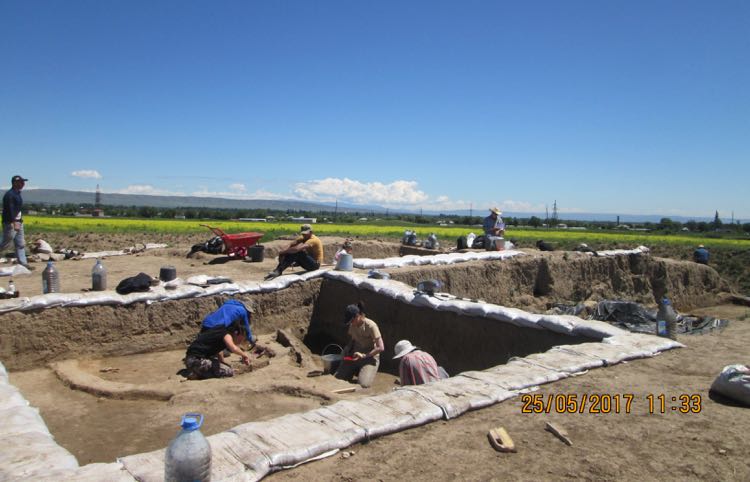
This analysis of archaeological, chemical, botanical, climatic and radiocarbon data at the two sites of Shulaveris Gora and Gadachrili Gora, in the province of Kvemo (Lower) Kartli, about 50 kilometers south of Tbilisi, gives a firm foundation to Georgia’s claim to 8,000 uninterrupted vintages, a claim they use as their enviable slogan. It is the chemical evidence for tartaric, malic, succinic and citric acids found in the clay jars that is particularly significant because these are the ‘fingerprint compounds’ for grapes from Vitis vinifera vines, those that are responsible for most of the world’s wine today.
The Georgian government and multiple agencies such as the Georgian National Wine Agency and the Georgian Wine Association have expended a considerable amount of time, money and effort over the last four years to re-examine these re-opened archaeological sites that had been investigated in the 1960s when available analytical methods were less precise.
The international team of scientists included anthropologist and biomolecular archaeologist Patrick McGovern of the University of Pennsylvania Museum of Archaeology and Anthropology, author of the extensive Oxford Companion to Wine entry on the origins of viniculture. With such significant claims, the dating had to be extremely precise.
The science behind the paper
For the scientists among you, here is an extract from the press release issued by Penn State Museum, explaining the methods used:
‘Numerous short-lived botanical samples (eg wheat and other seeds), as well as charcoal samples, from carefully excavated contexts in association with the wine jars were radiocarbon-dated by accelerator mass spectrometry. The analyses gave results within a narrowly calibrated range. Bayesian analysis confirmed that the earliest phase was ca. 6000-5800 B.C. with later phases extending down to about 5500 B.C. Earlier levels at Shulaveri remain to be excavated.
‘Additional chemical analyses by Fourier-transform infrared spectrometry (FT-IR) and gas chromatography-mass spectrometry (GC-MS) of the pottery, which was positive for tartaric acid, were less informative, but gave results consistent with those by LC-MS-MS. A notable finding was the absence of a tree resin, which was widely used in the ancient Near East to prevent wine going to vinegar. No other ingredients (e.g., medicinal herbs, honey, and cereals) were mixed with the wine, which was a common practice elsewhere.
‘Background chemical controls of the soils in which the wine jars were found showed that the organic acids of grape had not been produced by microorganisms.
'Archaeobotanical studies, including pollen, starch, and microfossil microscopic identification, showed the presence of grape starch, epidermis, and pollen in another early Neolithic jar from Gadachrili. Since cereal pollen was also found in the same vessel, this jar might have contained both beer and wine.
‘Climatic studies were based on pollen profiles from the Nariani wetland and Abkhazia region in western Georgia and Lake Van in Turkey, and allowing for differences in distance (100–350 kilometres) and elevation, rainfall and temperature could be projected back to the early Neolithic period in relation to modern climatic conditions. Indices appropriate for grapevine viability (eg Winkler and evapotranspiration) were calculated, showing that the climate was nearly identical to that of today and ideal for the Eurasian grapevine.’
Treasure in clay vessels
One thing that struck me about these discoveries was the significance of the clay fermenatation and storage vessels, known in Georgia as qvevri.
Clay is the key reason that there is still evidence of wine made around 8,000 years ago: ‘Pottery is the essential starting point of many biomolecular archaeological investigations. Barring the recovery of discernible physical residues of natural products constituting a food or drink, pottery has the advantage of being porous and an ionic (zeolitelike) material that absorbs liquids in particular and preserves them from environmental contamination for millennia until they are chemically extracted’, to quote from the article.
For more on qvevri and qvevri wines, see Georgian wines here and there.


